
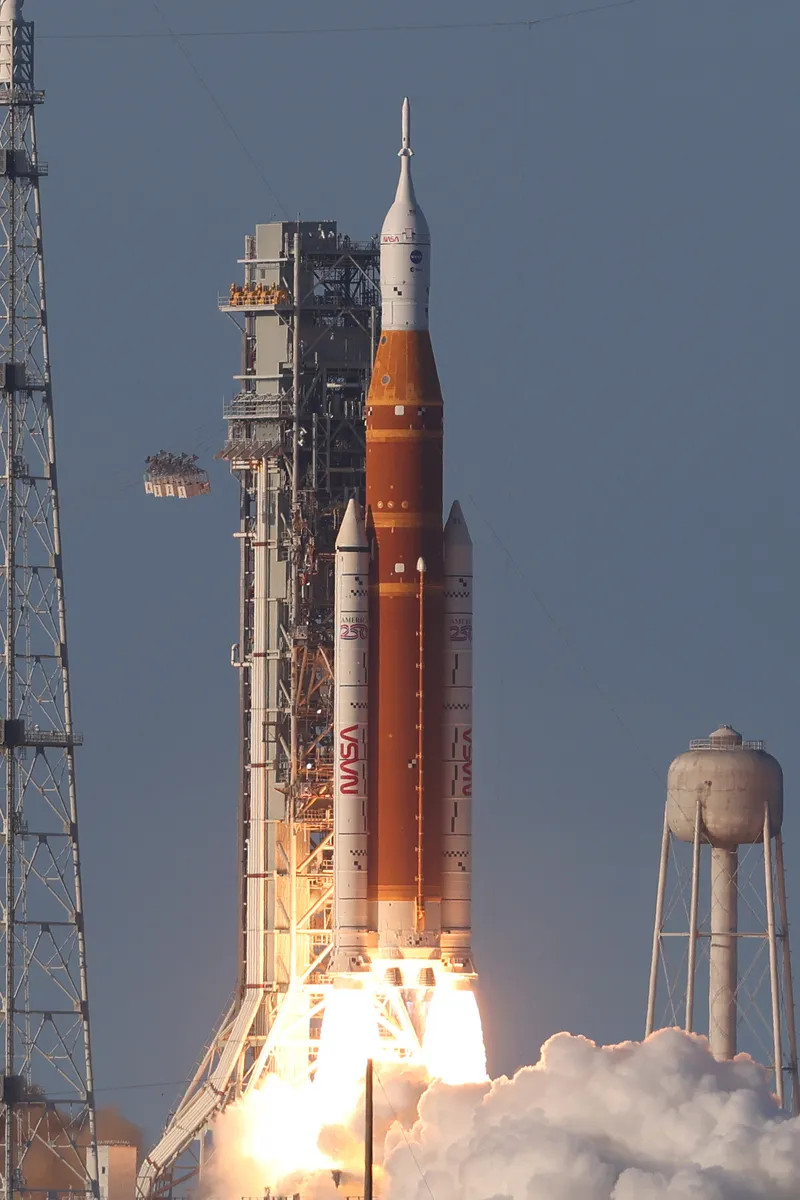
The April launch of NASA's Artemis II tore two holes roughly 5,000 kilometres wide in the Earth's ionosphere, disturbing GPS signals across the Americas, according to a study by researchers at Taiwan's National Cheng Kung University.
The launch that sent four astronauts around the Moon in April tore two holes roughly 5,000 kilometres wide in the Earth's ionosphere, disturbing GPS signals across the Americas, according to a study by researchers at Taiwan's National Cheng Kung University.
The team tracked the April 1 launch of NASA's Artemis II with data from about 3,500 ground-based GPS receivers, the same networks that monitor tectonic plate movement. The Space Launch System's 65-metre core stage carved the first disturbance as it climbed, and two burns of the upper stage, which sent the Orion capsule toward the Moon, left the second. Both stretched about 3,100 miles from east to west, and the disturbance was up to ten times stronger than those measured after SpaceX's Starship test launches.
The changes in electron density were equivalent to GPS positioning errors of several metres, the researchers found. That is enough to matter: co-author Charles Lin, an earth science professor at the university, told Space.com that an error of a couple of metres could nudge a self-driving car into another lane, and that drones could be affected too. Artemis II carried Reid Wiseman, Victor Glover, Christina Koch and Jeremy Hansen on a ten-day flight around the Moon, the first crewed lunar mission in more than half a century.
The study is a preprint posted for publication in Geophysical Research Letters, which means it has not yet been peer-reviewed and the final version may change. The picture is also more complicated than the headlines: the paper describes three disturbances, not two — a third followed a later engine burn — and the "several metres" GPS figure comes from Lin's interview, not from the paper itself, which measures electron density rather than recorded device errors. No navigation failures were documented on launch day. What the work establishes is that a single heavy launch can disturb the ionosphere on a continental scale.
Launches are getting bigger and more frequent, and the systems that depend on GPS — self-driving cars, drones, precision farming, aviation — assume the sky is stable. Artemis II shows it is not: a rocket punching through the ionosphere leaves a mark thousands of kilometres wide. Future Artemis missions and the growing cadence of heavy-lift flights will have to reckon with that, and with the question of whether the effect can be predicted and corrected for.
The paper is now before peer review. If its findings hold, launch planners will have one more variable to model: not just where a rocket goes, but what it does to the sky it passes through.