
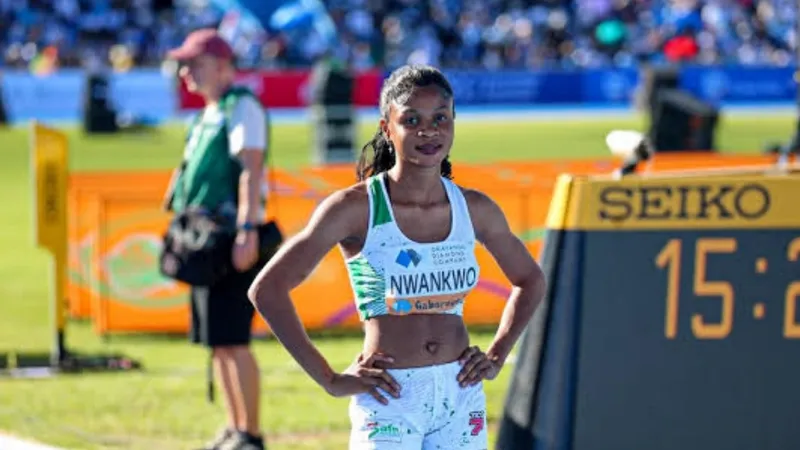
Rosemary Nwankwo and Gift Bright won both 100m gold medals for Nigeria at the Dakar 2026 Youth Olympic Games on Sunday, making Nigeria the first country to sweep both sprint titles at the same Youth Olympic edition.
Nigeria swept both 100m titles at the Dakar 2026 Youth Olympic Games on Sunday, with Rosemary Nwankwo and Gift Bright winning gold on the opening day of the athletics competition at the Complexe Iba Mar Diop. The two victories gave Nigeria its first medals of the Games, and made it the first country to claim both sprint crowns at the same edition of the Youth Olympics.
Nwankwo, the 17-year-old team captain, won the girls' final in a wind-assisted 11.16 seconds, finishing clear of Arwa Ali of the United Arab Emirates, who took silver in 11.41, and Dana Salem of Qatar, who claimed bronze in 11.48. Bright, just 15, completed the double in the boys' final with a personal best of 10.28 seconds, ahead of China's Zhang Hangyu in 10.57 and Poland's Szymon Dolega in 10.61. Both Nigerians had won their semi-finals earlier in the day, Nwankwo in 11.53 and Bright in 10.34.
The results put both teenagers into Nigerian athletics history. Nwankwo became the third Nigerian woman to win the Youth Olympic 100m title, following Josephine Omaka at Singapore 2010 and Rosemary Chukwuma at Buenos Aires 2018. Bright became the first Nigerian to win the boys' 100m title at the Youth Olympic Games. Dakar 2026 is the first Olympic event ever staged on African soil, with around 2,700 athletes aged 14 to 17 from more than 200 national Olympic committees competing until 13 November.
The times check out across the reporting, and the official results sit behind them. World Athletics published the official results for the finals, and the Olympics channel's own footage confirms Nwankwo as champion in 11.16. The wind readings matter for what the times mean: Nwankwo ran with a following wind of 2.4 metres per second, above the 2.0 limit for record purposes, so her 11.16 counts as a wind-assisted performance and not a record-eligible one. Bright's 10.28 came with a legal 1.7 metres per second tailwind, so it stands as a personal best. One outlet printed 11.15 for Nwankwo; the official results say 11.16.
For Nigerian athletics, the double is the clearest sign yet of a sprint pipeline producing at the youngest level. Nwankwo arrived in Dakar as team captain and the leading name in the squad; Bright, born in December 2010, was racing in his first major international final. Both won from the front, and both did it on the first day of track action, when the pressure of a first Games final is at its sharpest.
The athletics programme in Dakar runs until 10 November, with more finals to come before the Games close on Friday. Nigeria's two golds have put the country on the medal table for the first time at these Games, and the teenagers who delivered them will now be watched well beyond Dakar.