

Chemists isolate oxoboranes, elusive boron-oxygen molecules sought for more than 60 years
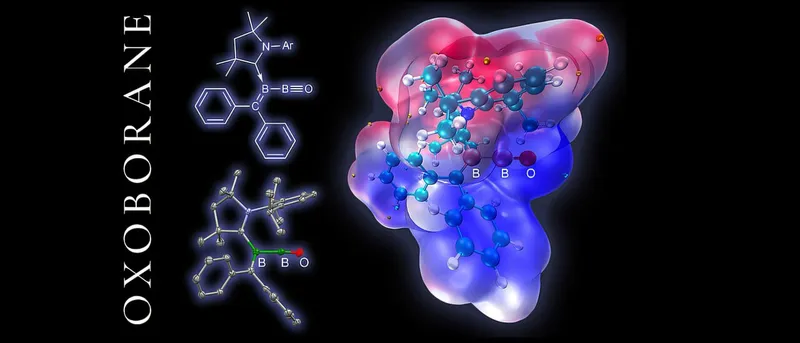
Chemists at the University of Würzburg have done what textbooks said could not be done: they have made and isolated oxoboranes, molecules built around a triple bond between boron and oxygen that researchers have chased since the early 1960s. The work, published in Nature Chemistry on October 27, ends a search that has stood for more than six decades.
The breakthrough came by accident. Doctoral students Lukas Lubczyk and Christian Markl were each running reactions between a highly reactive compound called a diboracumulene and different ketones, ordinary reagents in organic chemistry, when both noticed unusual orange or yellow solids forming. Against expectations, those solids turned out to be oxoboranes — and they formed as the main products of the reactions, not as fleeting traces. Using the new method, the team prepared three different oxoboranes, showing it is a general route rather than a one-off curiosity.
Boron has always been reluctant to form triple bonds, which is what made oxoboranes so elusive. Earlier attempts could only trap the molecules under extreme conditions or infer them from other reactions, and stabilised derivatives always carried extra chemical groups that dulled the very bond researchers wanted to study. The Würzburg team, led by Professor Holger Braunschweig with computational support from Professor Ashwini K. Phukan's group at Tezpur University in India, found a strikingly simple and mild way to make room-temperature-stable versions that can be isolated as crystalline solids.
The facts line up across the university's own release and the journal paper: three oxoboranes prepared, the diboracumulene-plus-ketone route, and the October 27 publication date in Nature Chemistry under the title Synthesis and isolation of stable oxoboranes. The result also completes a run of firsts for Braunschweig's group, which reported the first boron-boron triple bond in 2012 and the first neutral molecule with a boron-carbon triple bond in 2025. With oxoboranes, the last gap in that series of the periodic table's first row has now closed.
Having the molecules in hand changes what chemists can do with them. Until now, oxoboranes could only be studied indirectly; now their structure, bonding and reactivity can be probed directly, and the team has already shown two reactions in which the molecules add amines across the boron-oxygen bond. The group is now testing how far the method can be pushed, both to make more oxoboranes and to reach other elusive molecules across the periodic table.